
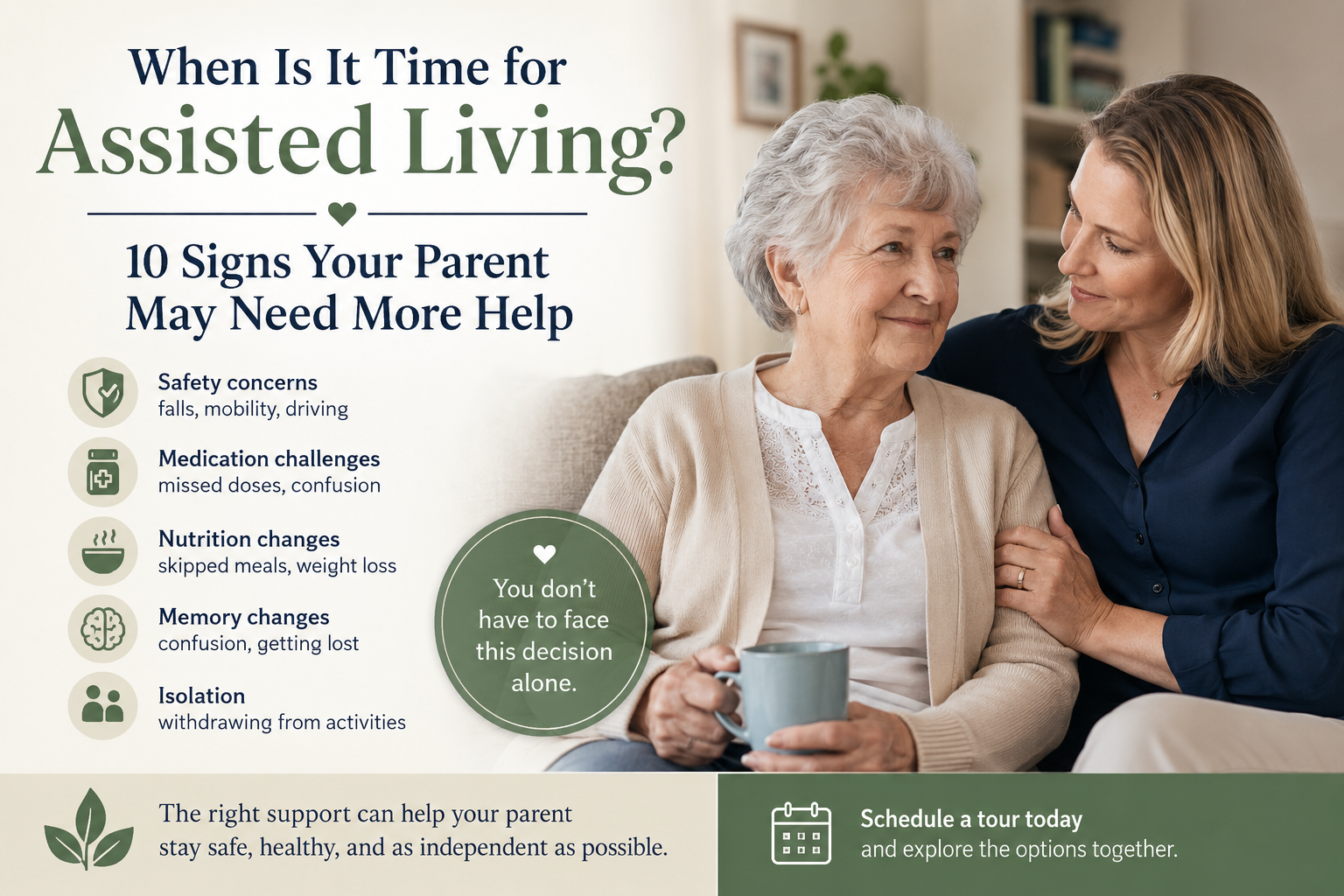
Watching a parent grow older can bring difficult questions. One of the hardest is: When is it time for assisted living?
There isn’t one age, diagnosis, or event that automatically means a parent should move to assisted living. Instead, the decision usually comes down to whether they can continue living safely and comfortably at home—and whether the support they need can realistically be provided there.
Some changes are easy to notice, such as a serious fall. Others develop gradually: unopened mail, missed medications, weight loss, increasing isolation, or difficulty keeping the house clean.
If you’re wondering whether your mom or dad may need more support, these 10 signs can help you evaluate the situation and start a productive family conversation.
What Is Assisted Living?
Assisted living is residential care for older adults who need help with everyday activities but don’t typically require the level of medical care provided by a nursing home.
Depending on the community and a resident’s individual needs, assisted living may provide:
- Help with bathing, dressing, grooming, and other personal care
- Medication assistance or management
- Prepared meals
- Housekeeping and laundry
- Transportation
- 24-hour staff availability and supervision
- Social programs and recreational activities
- Assistance with mobility and daily routines
The National Institute on Aging describes assisted living as an option for people who need help with daily care but don’t require as much assistance as a nursing home provides.
The goal isn’t simply to provide more care. A good assisted living environment should help an older adult maintain as much independence as possible while providing support where it’s needed.
10 Signs It May Be Time for Assisted Living
One isolated incident doesn’t necessarily mean your parent needs assisted living. A pattern of changes—particularly changes affecting safety, nutrition, medication, hygiene, mobility, or cognition—is more significant.
Here are 10 signs worth paying attention to.
1. Falls Are Becoming More Frequent
A fall can be one of the clearest indications that living independently is becoming more difficult.
You might notice:
- Unexplained bruises
- Difficulty getting out of a chair
- Trouble using stairs
- Holding onto furniture while walking
- Increasing dependence on a cane or walker
- A recent emergency room visit after a fall
- Fear of walking or leaving the house
Falls deserve attention even when they don’t cause a major injury. According to the National Institute on Aging, more than one in four adults age 65 and older fall each year, and fall risk increases with age.
A fall should also prompt a medical conversation. Medication side effects, vision changes, balance problems, muscle weakness, and certain health conditions can contribute to fall risk.
When to consider assisted living: Your parent has recurring falls, struggles with mobility, or cannot safely navigate the home without regular assistance.
2. Managing Medications Is Becoming Difficult
Medication mistakes can become a significant safety concern.
Look for:
- Missed doses
- Taking medication twice
- Confusion about prescriptions
- Expired medications accumulating
- Pills left in organizers
- Prescriptions not being refilled
- Difficulty remembering what each medication is for
Medication management becomes more complicated when someone takes several prescriptions on different schedules.
The National Institute on Aging notes that taking medications correctly and keeping track of them is an important part of medication safety for older adults.
When to consider assisted living: Medication reminders, pill organizers, or family check-ins are no longer enough to ensure medications are being taken safely.
3. Personal Hygiene Is Declining
Changes in grooming and hygiene can indicate that everyday tasks have become physically or cognitively difficult.
You may notice:
- Wearing the same clothes repeatedly
- Infrequent bathing
- Unwashed hair
- Body odor
- Difficulty shaving or grooming
- Poor oral hygiene
- Clothing inappropriate for the weather
Don’t assume these changes are simply a lack of interest. Your parent may have difficulty getting into the shower, fastening clothing, remembering routines, or admitting that they need help.
Poor hygiene is one of the signs the National Institute on Aging identifies as an indication that an older adult may need additional support.
When to consider assisted living: Your parent regularly needs assistance with bathing, dressing, grooming, or other activities of daily living.
4. Eating Habits or Weight Have Changed
Open the refrigerator during your next visit.
Is there fresh food? Are there complete meals available? Or do you find expired groceries, very little food, and signs that your parent has been skipping meals?
Warning signs can include:
- Unexplained weight loss
- Spoiled or expired food
- An unusually empty refrigerator
- Reliance on snacks instead of meals
- Difficulty grocery shopping
- Forgetting to eat
- Difficulty cooking safely
- Dehydration
Significant weight gain or loss can indicate that an older adult needs additional support, according to the National Institute on Aging.
There may also be a medical explanation, so unexplained weight changes should be discussed with a healthcare professional.
When to consider assisted living: Shopping, preparing nutritious meals, and eating regularly have become persistent problems despite family or home-based support.
5. The Home Is No Longer Being Maintained
For someone who once kept an organized home, a noticeable decline in housekeeping can be revealing.
Look for:
- Piles of unopened mail
- Overflowing trash
- Dirty dishes
- Laundry accumulating
- Unusual odors
- Neglected repairs
- Spoiled food
- Clutter creating walking hazards
- Utilities being disconnected because bills weren’t paid
The issue isn’t whether the house meets someone else’s standard of cleanliness. What matters is a change from your parent’s normal habits, especially when it creates health or safety risks.
When to consider assisted living: Routine household responsibilities have become overwhelming or unsafe and your parent cannot manage them consistently.
6. Memory Problems Are Affecting Safety
Occasionally forgetting a name or appointment doesn’t necessarily mean someone needs assisted living.
More concerning changes affect everyday functioning and safety.
Examples include:
- Leaving the stove on
- Getting lost in familiar places
- Forgetting important appointments repeatedly
- Missing bills
- Making unusual financial decisions
- Becoming confused about time or location
- Forgetting whether they’ve eaten or taken medication
- Repeatedly asking the same questions
The National Institute on Aging recommends medical attention when memory problems are accompanied by changes in thinking, personality, or decision-making.
If your parent has Alzheimer’s disease or another form of dementia, additional safety considerations may arise. The Alzheimer’s Association notes that people living with dementia can become lost or confused about their location, including in familiar environments.
When to consider assisted living: Cognitive changes are interfering with medication management, cooking, finances, driving, personal safety, or other essential activities.
Depending on the severity of cognitive impairment, a memory care community may be more appropriate than traditional assisted living.
7. Driving Is Becoming Unsafe
Giving up driving can feel like giving up independence, which makes this conversation particularly difficult.
Warning signs may include:
- New dents or scratches on the vehicle
- Traffic tickets
- Minor accidents
- Getting lost on familiar routes
- Confusing the gas and brake pedals
- Difficulty judging distance
- Driving unusually slowly or unpredictably
- Family members becoming uncomfortable riding with them
Stopping driving doesn’t automatically mean a person needs assisted living. Transportation from family, friends, community programs, or ride services may provide an alternative.
But transportation difficulties can compound other problems by making it harder to attend medical appointments, buy groceries, refill prescriptions, and maintain friendships.
When to consider assisted living: Your parent can no longer drive safely and transportation limitations are contributing to isolation or difficulty meeting essential needs.
8. Your Parent Is Increasingly Isolated
Safety isn’t the only consideration.
Quality of life matters too.
A parent who lives alone may gradually stop:
- Seeing friends
- Attending religious services
- Participating in hobbies
- Going shopping
- Exercising
- Leaving the house
- Participating in community activities
Loneliness and social isolation are among the signs the National Institute on Aging recommends families watch for when determining whether an older adult needs additional help.
Assisted living can provide easier access to meals with others, activities, transportation, common spaces, and social interaction.
When to consider assisted living: Your parent’s world has become increasingly small because mobility, transportation, health, or confidence makes social engagement difficult.
9. Family Caregiving Is No Longer Sustainable
Sometimes the biggest warning sign isn’t a change in your parent. It’s a change in the caregiving situation.
Ask yourself:
- Are family members providing care every day?
- Are you frequently leaving work to respond to emergencies?
- Are overnight calls becoming common?
- Is one sibling carrying most of the responsibility?
- Does your parent need more supervision than the family can provide?
- Are you constantly worried about what will happen when nobody is there?
Families often try to solve each new problem individually: grocery delivery, medication reminders, cameras, home health visits, transportation, cleaning services, and frequent check-ins.
Those solutions can work extremely well.
But eventually the number of separate solutions required may indicate that your parent’s overall level of care has changed.
When to consider assisted living: Keeping your parent safe requires near-constant coordination or supervision that family and home-based services can no longer reliably provide.
10. You Don’t Feel Comfortable Leaving Your Parent Alone
This may be the most important question on the list:
If your parent spent the next 24 to 48 hours completely alone, would you feel confident they would be safe?
Consider whether they could:
- Prepare meals safely
- Take medications correctly
- Respond to an emergency
- Get to the bathroom safely
- Avoid falling
- Recognize a dangerous situation
- Contact someone for help
- Manage nighttime needs
If your answer is consistently “no,” it’s worth evaluating whether their current living arrangement still matches their needs.
That doesn’t automatically mean assisted living is the answer. But it does mean the family should evaluate additional support rather than waiting for a crisis.
How Many Signs Mean It’s Time for Assisted Living?
There is no specific number of warning signs that determines when someone should enter assisted living.
Instead, consider three factors:
Frequency: Is the problem happening repeatedly?
Severity: Could the problem result in injury, hospitalization, malnutrition, medication errors, financial loss, or another serious consequence?
Support required: Can the problem reasonably be addressed at home, or does your parent now need regular assistance throughout the day?
One serious safety issue can sometimes matter more than five minor concerns.
For example, an untidy house may be manageable with housekeeping assistance. Repeatedly wandering away from home because of dementia is a very different level of risk.
Is It Assisted Living—or Does My Parent Need a Nursing Home?
Assisted living and nursing homes aren’t interchangeable.
Assisted living generally serves people who need help with daily activities while retaining a degree of independence.
Nursing homes provide a higher level of ongoing care and are generally appropriate for people with more extensive medical and personal-care needs.
The National Institute on Aging notes that assisted living typically includes personal-care assistance, meals, medication help, housekeeping, laundry, supervision, security, and social activities.
Someone recovering from an illness, surgery, or hospitalization may instead need short-term skilled nursing or rehabilitation, which is another distinct level of care. Medicare describes skilled nursing facilities as providing temporary rehabilitation and medical treatment following an illness or injury for people who meet eligibility requirements.
A physician, geriatric care professional, or qualified senior living professional can help your family determine which level of support is appropriate.
Can My Parent Stay at Home Instead?
Possibly.
Noticing these signs doesn’t mean you need to immediately move your parent.
Depending on their needs, alternatives may include:
- Home health services
- Personal-care aides
- Meal delivery
- Housekeeping
- Transportation services
- Adult day programs
- Medication management
- Home safety modifications
- Family caregiving
- Emergency response systems
The important question is whether those services can provide enough reliable support to keep your parent safe and maintain their quality of life.
If multiple services are needed throughout the day, overnight supervision becomes necessary, or your parent remains isolated despite receiving help, assisted living may become a more practical option.
How to Talk to a Parent About Assisted Living
Avoid beginning with: “You can’t live alone anymore.”
That can turn the discussion into an argument about independence.
Instead, start with what you’ve observed.
For example:
“I’ve noticed you’ve fallen twice recently, and I’m concerned about you being here alone at night. Can we look at some options that would give you more support while still letting you have your own space?”
Then listen.
Ask your parent what matters most to them:
- Staying near their current neighborhood?
- Keeping a pet?
- Having their own apartment?
- Remaining close to friends?
- Access to particular activities?
- Transportation?
- Religious or cultural preferences?
- Being near children or grandchildren?
Whenever possible, involve your parent early rather than waiting until a hospitalization or another emergency forces the family to make a decision quickly.
What Should You Do If You’re Seeing These Signs?
Start by documenting the changes you’ve noticed.
Then consider these steps:
- Talk with your parent. Ask where they’re struggling and what type of help they would accept.
- Schedule a medical evaluation. Sudden changes in memory, mobility, weight, mood, or daily functioning can have medical causes.
- Assess the home environment. Look for fall hazards, medication problems, food safety concerns, and other risks.
- Determine how much help is actually needed. Consider mornings, evenings, overnight needs, transportation, meals, medication, and personal care.
- Compare care options. Evaluate in-home care, assisted living, memory care, and other appropriate services.
- Tour communities before there’s an emergency. Starting early gives your parent more opportunity to participate in the decision.
Frequently Asked Questions About When to Consider Assisted Living
What is the most common reason seniors move to assisted living?
There isn’t one universal reason. Families often consider assisted living when an older adult begins needing regular help with activities such as bathing, dressing, medication management, meals, mobility, housekeeping, or personal safety. Assisted living is specifically designed for people who need help with daily care without necessarily requiring nursing-home-level care.
At what age should someone move into assisted living?
There is no “right” age for assisted living. Care needs, safety, health, mobility, cognitive function, and quality of life are more useful indicators than chronological age.
What are the biggest signs an elderly parent shouldn’t live alone?
Recurring falls, unsafe medication management, significant cognitive changes, inability to prepare meals, declining hygiene, wandering, unsafe driving, and inability to respond appropriately to emergencies are particularly important warning signs.
Should someone with dementia live in assisted living?
It depends on the person’s symptoms and the community’s capabilities. Someone with mild cognitive impairment may be able to live successfully in an assisted living environment with appropriate support. A person who requires specialized dementia programming, increased supervision, or enhanced safety measures may benefit from memory care.
Does Medicare pay for assisted living?
Original Medicare generally does not pay for the room, board, or long-term custodial care associated with assisted living. Medicare states that it doesn’t cover most long-term care when the primary need is assistance with activities of daily living.
Medicare may still cover eligible healthcare services a resident receives, while Medicaid assistance with long-term services varies by state and eligibility. Families should verify benefits based on their specific circumstances rather than assuming assisted living is covered.
How do I know if my parent needs assisted living or home care?
Consider the amount, frequency, and predictability of assistance required. Occasional help with housekeeping, transportation, or personal care may be manageable through home-based services. When your parent needs assistance with multiple daily activities, frequent supervision, meals, medication management, transportation, and social support, assisted living may provide a more comprehensive solution.
Don’t Wait for a Crisis to Start the Conversation
The best time to explore assisted living is often before it becomes an emergency.
A fall, hospitalization, medication mistake, or sudden cognitive decline can force families to make major decisions under pressure. Starting the conversation earlier gives you and your parent more time to understand the available options, tour communities, ask questions, and decide what type of environment feels right.
Most importantly, needing additional help doesn’t necessarily mean giving up independence.
For many older adults, the right level of support can make independence safer and more sustainable.
If you’re noticing several of these signs in your parent, consider scheduling a tour and speaking with our senior living team. We can help you understand what assisted living provides, discuss your parent’s individual needs, and determine whether our community may be a good fit.
Find Out More About Elm York Assisted Living And How We Can Help Your Loved Ones!


